Selecting the right foundry sand suppliers is often the silent determinant of casting quality and operational overhead in a modern foundry. While silica sand has been the traditional baseline, the shift toward high-refractoriness materials is driven by the need for tighter tolerances and a reduction in health-related liabilities such as silicosis.
For procurement managers and foundry engineers, the challenge lies in balancing the initial material cost against the long-term gains in reclamation rates and surface finish. The emergence of sintered ceramic sands has fundamentally altered the procurement logic, offering a synthetic alternative that outperforms natural sands in spherical consistency and thermal stability.
This analysis examines the critical technical benchmarks and supplier evaluation criteria necessary to optimize mold performance, reduce resin consumption, and ensure a stable supply chain for high-precision casting alloys.

The Shift Toward Synthetic Ceramic Sand in Modern Foundries

The foundry industry is currently navigating a transition from natural mineral sands to engineered ceramic solutions. Historically, silica sand dominated due to availability, but its high thermal expansion and associated health risks have pushed high-end manufacturers toward sintered ceramic sand. These synthetic materials are engineered to provide a consistent spherical shape, which is critical for fluid flow and mold collapse.
Unlike natural deposits, synthetic ceramic sand allows for precise control over the chemical composition—specifically Al₂O₃ levels (often ≥53%) and the minimization of Fe₂O₃—ensuring that the sand does not react with the molten metal. This chemical stability is essential for avoiding casting defects and ensuring a smooth surface finish that reduces the need for post-cast grinding.
Furthermore, the move toward synthetic options is often a strategic decision to decouple production from the volatility of natural sand mining. By partnering with industrial manufacturers capable of producing 200,000 MT annually, foundries can secure a stable supply of materials that meet ISO9001 and ISO14001 standards for quality and environmental management.
Technical Benchmarks for High-Performance Sintered Sands
Evaluating a supplier requires a deep dive into the physical and chemical properties of the grain. Sintered ceramic sand is characterized by its exceptional refractoriness, often exceeding 1800°C, making it versatile enough for almost any casting material without the need for multiple sand types. The spherical morphology is a key differentiator, significantly reducing the friction between grains during mold filling.
Key chemical markers include a low Loss on Ignition (L.O.I.
From a mechanical perspective, the bulk density (1.5-1.6 g/cm³) is approximately half that of fused ceramic or zircon sands. This lower density is not a weakness but an advantage, allowing foundries to produce nearly twice the number of molds per unit weight, which directly lowers labor and transfer power costs.
Critical Applications Across Diverse Casting Alloys
The versatility of neutral ceramic materials allows them to be deployed across a wide spectrum of metallurgical processes. In cast iron and cast steel production, the high refractoriness prevents sand burn-on, a common failure in silica-based molds. This makes it particularly effective for complex geometries where traditional sand might fuse to the casting.
For non-ferrous metals, such as aluminum and copper, the low thermal conductivity of sintered sand improves mold performance by controlling the cooling rate of the metal. This is critical for reducing internal stresses and preventing shrinkage defects in precision components. Applications include lost foam casting and resin-bonded sand systems.
Modern additive manufacturing is also integrating these materials. In 3D printing of sand molds, the precise particle size distribution (from 45μm to 2000μm) ensures high-resolution prints and optimal binder saturation, bridging the gap between traditional foundry techniques and digital fabrication.
Quantifying Efficiency: Thermal Expansion and Reclamation Metrics
The economic viability of a sand choice is measured by its reclamation rate. Sintered ceramic sand excels here because its spherical shape allows for easier separation from cast parts during mechanical reclamation. This leads to a higher recovery percentage and a significant reduction in the volume of new sand required per cycle.
Another critical metric is the thermal expansion coefficient. Silica sand expands significantly upon heating, often causing mold cracking or dimensional inaccuracies. In contrast, ceramic sand maintains a stable expansion rate (4.5-6.5x10⁻⁶/k), ensuring that the final dimensions of the casting are far more accurate.
foundry sand suppliers Performance Metrics
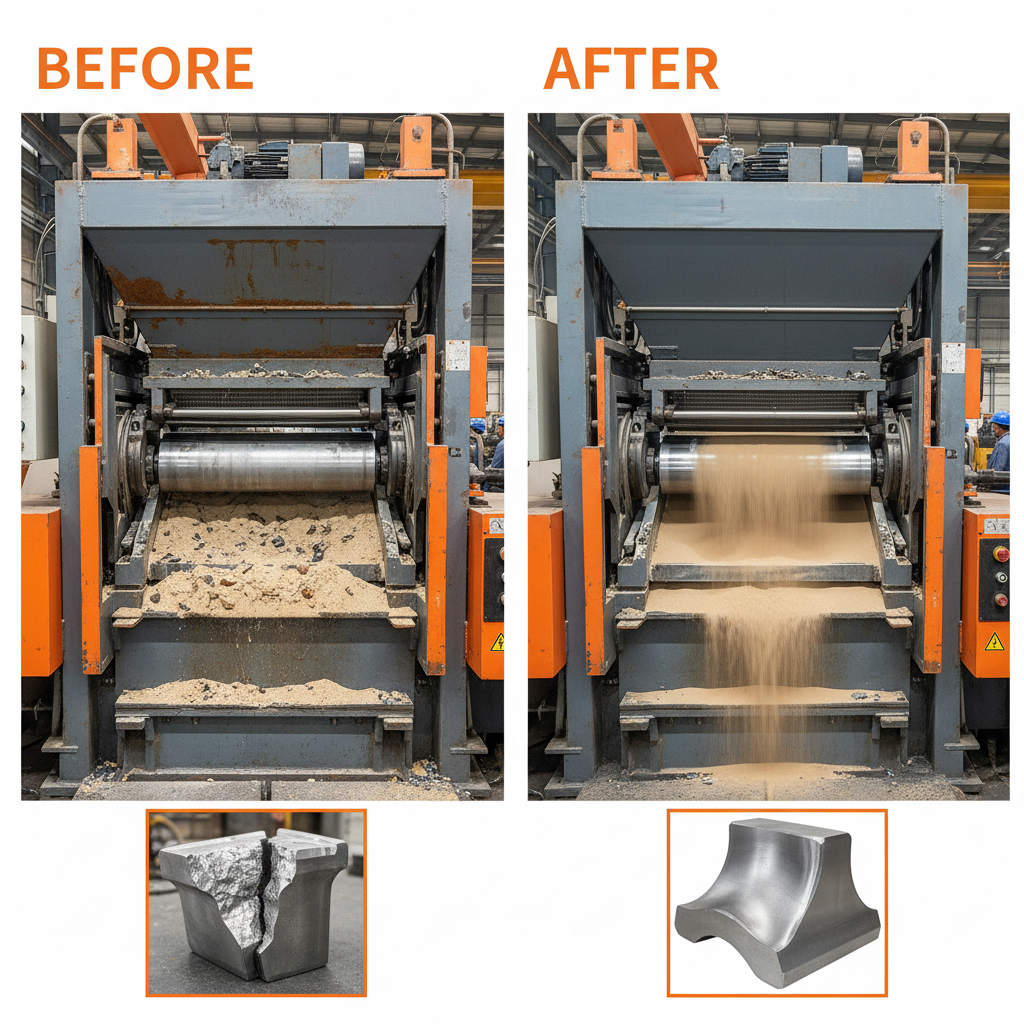
As illustrated in the comparison, the transition to synthetic ceramic sand typically results in a marked increase in reclamation efficiency and a decrease in binder requirements, directly impacting the total cost of ownership per casting.
Strategic Procurement and Supplier Risk Mitigation
When auditing foundry sand suppliers, the primary risk is inconsistency in particle size distribution. A shift in the AFS grain fineness number can alter the permeability of the mold, leading to gas defects in the casting. Procurement teams should insist on customizable PSD (Particle Size Distribution) to match their specific equipment.
Cost evaluation must move beyond the price per ton. The "Total Cost of Sand" includes the cost of resins, the cost of disposal for non-reclaimed sand, and the labor costs associated with cleaning castings. Because sintered ceramic sand requires 40-50% less resin and minimizes the need for mold coatings, the operational savings often outweigh the higher initial material price.
Finally, verify the supplier's certification status. ISO14001 certification is particularly important today, as it ensures that the production process of the sand itself is environmentally sustainable, helping the foundry meet its own green manufacturing targets.
Future Trends in Sustainable and AI-Driven Sand Management
The future of the foundry industry is leaning heavily toward "Zero Waste" sand cycles. We are likely to see an increase in the adoption of hybrid reclamation systems that combine thermal and mechanical processes to extend the life of sintered ceramic sands even further, potentially reducing fresh sand intake to minimal levels.
AI is also beginning to play a role in sand management. Predictive analytics can now be used to monitor the degradation of sand properties in real-time, adjusting binder ratios automatically based on the current state of the sand bed. This precision reduces waste and ensures consistent casting quality across thousands of cycles.
Furthermore, the development of specialized ceramic sands for 3D printing is expected to expand. As the industry moves toward more organic, topology-optimized designs, the demand for ultra-fine, highly spherical ceramic grains will grow, pushing suppliers to innovate in the sintering and classification process.
Comparative Matrix for Selecting the Optimal Sand Type
Selecting a sand type is a trade-off between performance and budget. While silica is the cheapest, its limitations in high-temperature steel casting are significant. Zircon sand offers excellent refractoriness but is heavy and expensive. Sintered ceramic sand provides a middle ground, offering performance near that of zircon with the handling advantages of a lighter material.
The following matrix provides a technical comparison based on typical foundry operating conditions and material requirements.
| Sand Material | Thermal Expansion | Reclamation Rate | Best Use Case |
|---|---|---|---|
| Silica Sand | High | Moderate | General low-temp casting |
| Zircon Sand | Very Low | Low/Difficult | High-precision thin walls |
| Chromite Sand | Low | Moderate | Heavy steel sections |
| Sintered Ceramic | Low | Very High | High-temp diverse alloys |
| Fused Ceramic | Low | High | Precision industrial molds |
| Kyanite Sand | Moderate | Moderate | Specialized refractory cores |
For foundries seeking to optimize production and lower the risk of silicosis, the transition to a sintered ceramic solution is the most sustainable long-term strategy. Detailed specifications and customized particle distributions can be explored through www.sinoceramsite.com.
Frequently Asked Questions
Conclusion
The evolution of foundry materials is moving decisively toward engineered solutions that prioritize both precision and sustainability. By shifting the focus from the purchase price of the sand to the total operational efficiency—including resin savings and reclamation rates—foundries can achieve a significant competitive advantage in casting quality.
Whether managing cast iron, stainless steel, or non-ferrous alloys, the adoption of sintered ceramic sand represents a strategic upgrade in mold performance. Readers evaluating their current sand supply chain can review relevant technical data and company capabilities through www.sinoceramsite.com.